ACTION: Background music plays as all three speakers chat and receive drinks. Title content appears on screen.
SUPER:
Expert and Patient Perspectives
Managing DRUG-DRUG INTERACTIONS WITH LAI PrEP
[Dr Mohamed] This is so much more fun. I love that side of you, pharma mama.
ACTION: Speakers on frame and content will animate onto frame.
SUPER:
NASSER MOHAMED, MD has been compensated by ViiV Healthcare.
LEO A real patient sharing their personal experience who has been compensated by ViiV Healthcare. Individual results may vary.
CHRISTINA HARBISON, PharmD has been compensated by ViiV Healthcare.
ViiV Healthcare logo
[Dr Mohamed] Thank you for being here. And thank you for tuning in.
ACTION: Speakers and content on frame, content leaves frame shortly thereafter.
SUPER:
NASSER MOHAMED, MD has been compensated by ViiV Healthcare
LEO A real patient receiving APRETUDE and has been compensated by ViiV Healthcare
CHRISTINA HARBISON, PharmD has been compensated by ViiV Healthcare
ViiV Healthcare logo
[Dr Mohamed] My name is Dr Nas, and I'm joined by Dr Harbison and our patient ambassador, Leo.
[Dr Harbison] Today we're going to discuss drug-drug interactions with long-acting injectable PrEP. Throughout, you'll hear from both providers and patients on how these considerations play out in the real world.
[Dr Mohamed] And to connect the topic to real stories, we're going to start with our patient ambassador Leo and hear about their journey.
ACTION: Speakers on frame.
SUPER:
ViiV Healthcare logo
[Leo] Well, I feel like I’ve lived many lives. Growing up in a small, rural town, I had a pretty normal childhood. I played lots of sports, worked a lot of jobs. Had relationships with boys that remain, you know, pretty surface level. And I didn't yet have the language for who I was becoming. At 19, I found myself in a spiral of active addiction, a toxic relationship, and reckless behavior.
ACTION: Speakers on frame.
SUPER:
ViiV Healthcare logo
[Leo] After we [my girlfriend and I] broke up, I started sleeping around without using protection, simply just because I didn't really know the forms of protection other assigned female birth individuals could use with each other.
ACTION: Speakers on frame.
SUPER:
ViiV Healthcare logo
[Leo] I didn’t care much about anything or anyone, much less myself. I started working in the sex industry, primarily in strip clubs. And after a couple years of reckless living, I found myself in rehab at 21. During that time, I reflected on my past choices. And when I got out, I decided it was time to take care of myself.
Once back on my feet, I got an HIV test and was absolutely terrified to get the results, given my sexual behavior over the previous few years. My result was negative though, and that was the first time someone talked to me about PrEP as an AFAB individual.
ACTION: Speakers on frame.
SUPER:
ViiV Healthcare logo
[Dr Mohamed] Thank you for sharing all of that with us. I know it's quite intimate, and not a lot of people have the ability to put this out, let alone share it with an audience. So, I want to acknowledge that.
[Leo] Thank you.
[Dr Harbison] I’m glad you shared your story.
ACTION: Speakers on frame.
SUPER:
ViiV Healthcare logo
[Dr Mohamed] When I see the patient, I let them know sometimes up-front that there is not anything that you're doing or not doing that will make me disengage from your care.
[Dr Harbison] That's a great way to approach patients. I'm going to take that back and use it in my clinics.
ACTION: Speakers on frame, content will animate onto frame.
SUPER:
Please see accompanying full Prescribing Information, including Boxed Warning, for APRETUDE.
APRETUDE logo
[Dr Mohamed] Great. When I prescribe a PrEP option for my patients for HIV prevention, APRETUDE is often on the table.
ACTION: ISI animates onto frame; animated graphic for video countdown will appear.
SUPER:
INDICATION
APRETUDE is indicated for pre-exposure prophylaxis (PrEP) to reduce the risk of sexually acquired HIV-1 infection in adults and adolescents weighing at least 35 kg who are at risk for HIV-1 acquisition. Individuals must have a negative HIV-1 test prior to initiating APRETUDE (with or without an oral lead-in with oral cabotegravir) for HIV-1 PrEP.
Please see Important Safety Information for APRETUDE throughout.
Please see accompanying full Prescribing Information, including Boxed Warning, for APRETUDE.
APRETUDE logo
[Voiceover] APRETUDE is indicated for PrEP to reduce the risk of sexually acquired HIV-1 infection in adults and adolescents weighing at least 35 kg or 77 pounds who are at risk for HIV-1 acquisition. Individuals must have a negative HIV-1 test prior to initiating APRETUDE.
ACTION: ISI animates onto frame; animated graphic for video countdown will appear.
SUPER:
IMPORTANT SAFETY INFORMATION
BOXED WARNING: RISK OF DRUG RESISTANCE WITH USE OF APRETUDE FOR HIV-1 PRE-EXPOSURE PROPHYLAXIS (PrEP) IN UNDIAGNOSED HIV-1 INFECTION
Individuals must be tested for HIV-1 infection prior to initiating APRETUDE or oral cabotegravir, and with each subsequent injection of APRETUDE, using a test approved or cleared by the FDA for the diagnosis of acute or primary HIV-1 infection. Drug-resistant HIV-1 variants have been identified with use of APRETUDE by individuals with undiagnosed HIV-1 infection. Do not initiate APRETUDE for HIV-1 PrEP unless negative infection status is confirmed. Individuals who acquire HIV-1 while receiving APRETUDE for PrEP must transition to a complete HIV-1 treatment regimen.
Please see Important Safety Information for APRETUDE throughout.
Please see accompanying full Prescribing Information, including Boxed Warning, for APRETUDE.
APRETUDE logo
[Voiceover] Now we’ll cover the Important Safety Information for APRETUDE.
BOXED WARNING: RISK OF DRUG RESISTANCE WITH USE OF APRETUDE FOR HIV-1 PRE-EXPOSURE PROPHYLAXIS (PrEP) IN UNDIAGNOSED HIV-1 INFECTION
Individuals must be tested and confirmed to be HIV negative prior to starting PrEP with either oral or long-acting injectable cabotegravir and with each subsequent injection of APRETUDE. The test used to screen for HIV should be approved or cleared by the FDA for diagnosis of acute or primary HIV-1. Drug-resistant HIV variants have been identified with use of APRETUDE in the presence of undiagnosed infection. If a person becomes infected with HIV while receiving APRETUDE, they must transition to a complete HIV treatment regimen.
ACTION: ISI animates onto frame; animated graphic for video countdown will appear.
SUPER:
IMPORTANT SAFETY INFORMATION (cont’d)
CONTRAINDICATIONS
- Do not use APRETUDE in individuals:
- with unknown or positive HIV-1 status
- with previous hypersensitivity reaction to cabotegravir
- receiving carbamazepine, oxcarbazepine, phenobarbital, phenytoin, rifampin, and rifapentine
Please see Important Safety Information for APRETUDE throughout.
Please see accompanying full Prescribing Information, including Boxed Warning, for APRETUDE.
APRETUDE logo
[Voiceover] APRETUDE is contraindicated in those with unknown or positive HIV status. Additionally, do not use APRETUDE in people who have had a hypersensitivity reaction to cabotegravir or in combination with the medicines listed on the slide.
ACTION: Speakers on frame.
SUPER:
APRETUDE logo
[Dr Mohamed] What are your thoughts about drug-drug interactions when it comes to long-acting injectable PrEP medications?
[Dr Harbison] So, it's very important to consider because the medications lower the concentration of APRETUDE, also YEZTUGO, in their bloodstream. So, what happens when PrEP doesn't work? You can contract HIV.
ACTION: Speakers on frame.
SUPER:
APRETUDE logo
[Leo] Yeah.
[Dr Mohamed] And also, when we talk about drug-drug interactions, we're not necessarily only talking about prescription drugs, right? We're talking about an over-the-counter supplement that people might be taking. Or it could be a recreational drug that people are using.
So, these are important conversations, because that interaction [can] happen in both ways. It doesn't only lower and decrease the efficacy of the PrEP drug that we're taking, but it may increase the toxicity profile of the other drugs that we're taking.
ACTION: Speakers on frame.
SUPER:
APRETUDE logo
[Dr Harbison] Given the long-acting nature of injectable PrEP, it's important to educate patients on drug-drug interactions.
ACTION: Content animates full screen onto the frame.
SUPER:
DRUG-DRUG INTERACTIONS AND LONG-ACTING INJECTABLE PrEP
EFFECT OF OTHER DRUGS ON APRETUDE (cabotegravir)
APRETUDE Prescribing Information includes the below information on contraindicated drugs.
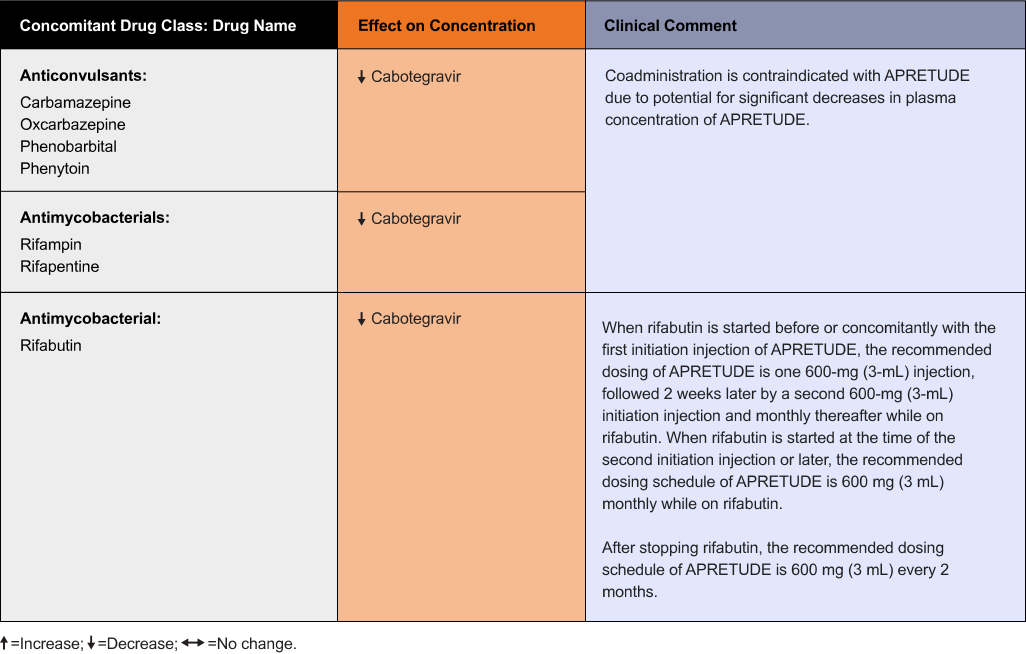
APRETUDE is primarily metabolized by UGT1A1 with some contribution from UGT1A9. Drugs that are strong inducers of UGT1A1 or 1A9 are expected to decrease cabotegravir plasma concentrations; therefore, coadministration of APRETUDE with these drugs is contraindicated.
Contraindicated strong UGT1A1 and UGT1A9 inducers from APRETUDE PI:
carbamazepine (TEGRETOL)
oxcarbazepine (OXTELLAR)
phenobarbital (LUMINAL)
phenytoin (DILANTIN)
rifampin (RIFADIN)
rifapentine (PRIFTIN)
APRETUDE dosage adjustments with rifabutin
Supplemental doses of APRETUDE are recommended with concomitant use of rifabutin, an anti-mycobacterial. Please see APRETUDE PI for additional dosing recommendations.
EFFECT OF OTHER DRUGS ON YEZTUGO (lenacapavir)
YEZTUGO Prescribing Information has no listed contraindicated drugs.1
YEZTUGO is metabolized by CYP3A and UGT1A1 (minor). Combined P-gp, UGT1A1, and strong CYP3A inhibitors may significantly increase plasma concentrations of YEZTUGO. Concomitant administration of YEZTUGO with these inhibitors is not recommended.1
Drugs that are strong or moderate inducers of CYP3A may significantly decrease plasma concentrations of lenacapavir, which may reduce the effectiveness of YEZTUGO. Therefore, dosage modifications (supplemental doses) of YEZTUGO are recommended when initiating strong or moderate CYP3A inducers.1
Examples of strong or moderate CYP3A inducers (non-exhaustive)2,3:
dexamethasone (DECADRON)
rifampin (RIFADIN)
phenytoin (DILANTIN)
carbamazepine (TEGRETOL)
phenobarbital (LUMINAL)
YEZTUGO dosage adjustments with strong or moderate CYP3A inducers
Supplemental doses of YEZTUGO are recommended for individuals initiating therapy with either strong or moderate CYP3A inducers.1 You can find a non-exhaustive list of CYP3A inducers above. Please see YEZTUGO PI for additional dosing recommendations.
EFFECT OF YEZTUGO ON OTHER DRUGS
YEZTUGO is a moderate inhibitor of CYP3A and a P-gp inhibitor. The co-administration of YEZTUGO with sensitive substrates of CYP3A or P-gp may increase the concentrations of these substrates and result in the increased risk of their adverse events.1 See the prescribing information of these sensitive substrates for dosing recommendations or appropriate monitoring of safety.
Examples of CYP3A substrates (non-exhaustive)2,3:
fentanyl (DURAGESIC)
oxycodone (OXYCONTIN/PERCOCET)
salmeterol (ADVAIR)
sildenafil (VIAGRA)
simvastatin (ZOCOR)
budesonide (PULMICORT)
buspirone (BUSPAR)
quetiapine (SEROQUEL)
felodipine (PLENDIL)
alprazolam (XANAX)
apixaban (ELIQUIS)
clonazepam (KLONOPIN)
diazepam (VALIUM)
fluticasone (FLONASE)
tadalafil (CIALIS)
warfarin (COUMADIN)
rivaroxaban (XARELTO)
amlodipine (NORVASC)
saxagliptin (ONGLYZA)
fludrocortisone (FLORINEF)
Examples of P-gp substrates (non-exhaustive)2,3:
fexofenadine (ALLEGRA)
digoxin (DIGITEK)
edoxaban (SAVAYSA)
dabigatran (PRADAXA)
apixaban (ELIQUIS)
No comparative efficacy or safety conclusions can be drawn from these tables.
Potential drug interactions for APRETUDE and YEZTUGO are primarily based on the pharmacokinetic properties of each drug, and specific drug interaction studies may not have been conducted for each interaction.1 This is not intended to compare safety or efficacy of the products. The examples provided are for ease of reference, and the lists included are not exhaustive and may not include all potential drug interactions. Not all DDIs have the same impact; clinicians should carefully weigh the risks versus benefits.
1. YEZTUGO. Prescribing Information. Gilead Sciences, Inc.; 2025. 2. For healthcare professionals: FDA’s examples of drugs that interact with CYP enzymes and transporter systems. FDA.gov. Updated June 27, 2025. Downloaded September 10, 2025. https://www.fda.gov/drugs/drug-interactions-labeling/healthcare-professionals-fdas-examples-drugs-interact-cyp-enzymes-and-transporter-systems 3. Liverpool HIV drug interaction checker. Accessed September 10, 2025. https://www.hiv-druginteractions.org/checker
APRETUDE logo
[Dr Harbison] Both APRETUDE and YEZTUGO offer long-acting HIV protection. But they have distinct metabolic pathways and pharmacologic profiles. There is potential for other drugs to affect both APRETUDE and YEZTUGO.
ACTION: Content zooms into “EFFECT OF OTHER DRUGS ON APRETUDE.”
SUPER:
DRUG-DRUG INTERACTIONS AND LONG-ACTING INJECTABLE PrEP
EFFECT OF OTHER DRUGS ON APRETUDE (cabotegravir)
APRETUDE Prescribing Information includes the below information on contraindicated drugs.
APRETUDE is primarily metabolized by UGT1A1 with some contribution from UGT1A9. Drugs that are strong inducers of UGT1A1 or 1A9 are expected to decrease cabotegravir plasma concentrations; therefore, coadministration of APRETUDE with these drugs is contraindicated.
Contraindicated strong UGT1A1 and UGT1A9 inducers from APRETUDE PI:
carbamazepine (TEGRETOL)
oxcarbazepine (OXTELLAR)
phenobarbital (LUMINAL)
phenytoin (DILANTIN)
rifampin (RIFADIN)
rifapentine (PRIFTIN)
APRETUDE dosage adjustments with rifabutin
Supplemental doses of APRETUDE are recommended with concomitant use of rifabutin, an anti-mycobacterial. Please see APRETUDE PI for additional dosing recommendations.
No comparative efficacy or safety conclusions can be drawn from these tables.
Potential drug interactions for APRETUDE and YEZTUGO are primarily based on the pharmacokinetic properties of each drug, and specific drug interaction studies may not have been conducted for each interaction.1 This is not intended to compare safety or efficacy of the products. The examples provided are for ease of reference, and the lists included are not exhaustive and may not include all potential drug interactions. Not all DDIs have the same impact; clinicians should carefully weigh the risks versus benefits.
1. YEZTUGO. Prescribing Information. Gilead Sciences, Inc.; 2025. 2. For healthcare professionals: FDA’s examples of drugs that interact with CYP enzymes and transporter systems. FDA.gov. Updated June 27, 2025. Downloaded September 10, 2025. https://www.fda.gov/drugs/drug-interactions-labeling/healthcare-professionals-fdas-examples-drugs-interact-cyp-enzymes-and-transporter-systems 3. Liverpool HIV drug interaction checker. Accessed September 10, 2025. https://www.hiv-druginteractions.org/checker
APRETUDE logo
[Dr Harbison] APRETUDE is primarily metabolized through UGT1A1, with some contribution from UGT1A9. Coadministration from the drugs listed on the screen, including carbamazepine, oxcarbazepine, phenobarbital, phenytoin, rifampin, and rifapentine, is contraindicated. If your patient is taking rifabutin, refer to APRETUDE Prescribing Information for dose adjustments.
ACTION: Content zooms into “EFFECT OF OTHER DRUGS ON YEZTUGO.”
SUPER:
DRUG-DRUG INTERACTIONS AND LONG-ACTING INJECTABLE PrEP
EFFECT OF OTHER DRUGS ON YEZTUGO (lenacapavir)
YEZTUGO Prescribing Information has no listed contraindicated drugs.1
YEZTUGO is metabolized by CYP3A and UGT1A1 (minor). Combined P-gp, UGT1A1, and strong CYP3A inhibitors may significantly increase plasma concentrations of YEZTUGO. Concomitant administration of YEZTUGO with these inhibitors is not recommended.1
Drugs that are strong or moderate inducers of CYP3A may significantly decrease plasma concentrations of lenacapavir, which may reduce the effectiveness of YEZTUGO. Therefore, dosage modifications (supplemental doses) of YEZTUGO are recommended when initiating strong or moderate CYP3A inducers.1
Examples of strong or moderate CYP3A inducers (non-exhaustive)2,3:
dexamethasone (DECADRON)
rifampin (RIFADIN)
phenytoin (DILANTIN)
carbamazepine (TEGRETOL)
phenobarbital (LUMINAL)
YEZTUGO dosage adjustments with strong or moderate CYP3A inducers
Supplemental doses of YEZTUGO are recommended for individuals initiating therapy with either strong or moderate CYP3A inducers.1 You can find a non-exhaustive list of CYP3A inducers above. Please see YEZTUGO PI for additional dosing recommendations.
No comparative efficacy or safety conclusions can be drawn from these tables.
Potential drug interactions for APRETUDE and YEZTUGO are primarily based on the pharmacokinetic properties of each drug, and specific drug interaction studies may not have been conducted for each interaction.1 This is not intended to compare safety or efficacy of the products. The examples provided are for ease of reference, and the lists included are not exhaustive and may not include all potential drug interactions. Not all DDIs have the same impact; clinicians should carefully weigh the risks versus benefits.
1. YEZTUGO. Prescribing Information. Gilead Sciences, Inc.; 2025. 2. For healthcare professionals: FDA’s examples of drugs that interact with CYP enzymes and transporter systems. FDA.gov. Updated June 27, 2025. Downloaded September 10, 2025. https://www.fda.gov/drugs/drug-interactions-labeling/healthcare-professionals-fdas-examples-drugs-interact-cyp-enzymes-and-transporter-systems 3. Liverpool HIV drug interaction checker. Accessed September 10, 2025. https://www.hiv-druginteractions.org/checker
APRETUDE logo
[Dr Harbison] YEZTUGO’s metabolized by CYP3A and UGT1A1. Concomitant administration with both combined p-glycoprotein UGT1A1 and strong CYP3A inhibitors increases the concentration of YEZTUGO and is not recommended. Additionally, strong or moderate CYP3A inducers may reduce the effectiveness of YEZTUGO, meaning the supplemental doses are recommended.
ACTION: Content zooms out, with “EFFECT OF YEZTUGO ON OTHER DRUGS” highlighted.
SUPER:
DRUG-DRUG INTERACTIONS AND LONG-ACTING INJECTABLE PrEP
EFFECT OF YEZTUGO ON OTHER DRUGS
YEZTUGO is a moderate inhibitor of CYP3A and a P-gp inhibitor. The co-administration of YEZTUGO with sensitive substrates of CYP3A or P-gp may increase the concentrations of these substrates and result in the increased risk of their adverse events.1 See the prescribing information of these sensitive substrates for dosing recommendations or appropriate monitoring of safety.
Examples of CYP3A substrates (non-exhaustive)2,3:
fentanyl (DURAGESIC)
oxycodone (OXYCONTIN/PERCOCET)
salmeterol (ADVAIR)
sildenafil (VIAGRA)
simvastatin (ZOCOR)
budesonide (PULMICORT)
buspirone (BUSPAR)
quetiapine (SEROQUEL)
felodipine (PLENDIL)
alprazolam (XANAX)
apixaban (ELIQUIS)
clonazepam (KLONOPIN)
diazepam (VALIUM)
fluticasone (FLONASE)
tadalafil (CIALIS)
warfarin (COUMADIN)
rivaroxaban (XARELTO)
amlodipine (NORVASC)
saxagliptin (ONGLYZA)
fludrocortisone (FLORINEF)
Examples of P-gp substrates (non-exhaustive)2,3:
fexofenadine (ALLEGRA)
digoxin (DIGITEK)
edoxaban (SAVAYSA)
dabigatran (PRADAXA)
apixaban (ELIQUIS)
No comparative efficacy or safety conclusions can be drawn from these tables.
Potential drug interactions for APRETUDE and YEZTUGO are primarily based on the pharmacokinetic properties of each drug, and specific drug interaction studies may not have been conducted for each interaction.1 This is not intended to compare safety or efficacy of the products. The examples provided are for ease of reference, and the lists included are not exhaustive and may not include all potential drug interactions. Not all DDIs have the same impact; clinicians should carefully weigh the risks versus benefits.
1. YEZTUGO. Prescribing Information. Gilead Sciences, Inc.; 2025. 2. For healthcare professionals: FDA’s examples of drugs that interact with CYP enzymes and transporter systems. FDA.gov. Updated June 27, 2025. Downloaded September 10, 2025. https://www.fda.gov/drugs/drug-interactions-labeling/healthcare-professionals-fdas-examples-drugs-interact-cyp-enzymes-and-transporter-systems 3. Liverpool HIV drug interaction checker. Accessed September 10, 2025. https://www.hiv-druginteractions.org/checker
APRETUDE logo
[Dr Harbison] Now we'll look into the effect of APRETUDE and YEZTUGO on other drugs. APRETUDE has no known effect on other drugs.
ACTION: Content zooms into “EFFECT OF YEZTUGO ON OTHER DRUGS.”
SUPER:
DRUG-DRUG INTERACTIONS AND LONG-ACTING INJECTABLE PrEP
EFFECT OF YEZTUGO ON OTHER DRUGS
YEZTUGO is a moderate inhibitor of CYP3A and a P-gp inhibitor. The co-administration of YEZTUGO with sensitive substrates of CYP3A or P-gp may increase the concentrations of these substrates and result in the increased risk of their adverse events.1 See the prescribing information of these sensitive substrates for dosing recommendations or appropriate monitoring of safety.
Examples of CYP3A substrates (non-exhaustive)2,3:
fentanyl (DURAGESIC)
oxycodone (OXYCONTIN/PERCOCET)
salmeterol (ADVAIR)
sildenafil (VIAGRA)
simvastatin (ZOCOR)
budesonide (PULMICORT)
buspirone (BUSPAR)
quetiapine (SEROQUEL)
felodipine (PLENDIL)
alprazolam (XANAX)
apixaban (ELIQUIS)
clonazepam (KLONOPIN)
diazepam (VALIUM)
fluticasone (FLONASE)
tadalafil (CIALIS)
warfarin (COUMADIN)
rivaroxaban (XARELTO)
amlodipine (NORVASC)
saxagliptin (ONGLYZA)
fludrocortisone (FLORINEF)
Examples of P-gp substrates (non-exhaustive)2,3:
fexofenadine (ALLEGRA)
digoxin (DIGITEK)
edoxaban (SAVAYSA)
dabigatran (PRADAXA)
apixaban (ELIQUIS)
No comparative efficacy or safety conclusions can be drawn from these tables.
Potential drug interactions for APRETUDE and YEZTUGO are primarily based on the pharmacokinetic properties of each drug, and specific drug interaction studies may not have been conducted for each interaction.1 This is not intended to compare safety or efficacy of the products. The examples provided are for ease of reference, and the lists included are not exhaustive and may not include all potential drug interactions. Not all DDIs have the same impact; clinicians should carefully weigh the risks versus benefits.
1. YEZTUGO. Prescribing Information. Gilead Sciences, Inc.; 2025. 2. For healthcare professionals: FDA’s examples of drugs that interact with CYP enzymes and transporter systems. FDA.gov. Updated June 27, 2025. Downloaded September 10, 2025. https://www.fda.gov/drugs/drug-interactions-labeling/healthcare-professionals-fdas-examples-drugs-interact-cyp-enzymes-and-transporter-systems 3. Liverpool HIV drug interaction checker. Accessed September 10, 2025. https://www.hiv-druginteractions.org/checker
APRETUDE logo
[Dr Harbison] As a moderate inhibitor of CYP3A and p-glycoprotein, YEZTUGO can increase the plasma concentration of drugs that are substrates of these pathways. Concomitant administration of YEZTUGO with these drugs may result in increased adverse events. Examples include fentanyl, oxycodone, salmeterol, diazepam, and some drugs indicated for erectile dysfunction, such as sildenafil and tadalafil.
ACTION: Speakers on frame.
SUPER:
APRETUDE logo
[Dr Mohamed] I want to switch back to you. How about yourself? Like, how do you approach these topics as a pharmacist yourself and what concerns do you have?
[Dr Harbison] So, when we are looking at long-acting injectables or just any medications at all, we're always communicating with the patient and making sure that they do tell us everything. When you do have a drug that does interact and decrease the concentrations, then you do what the manufacturer recommends.
In addition to that, as pharmacists, what kind of drug interaction is it? Is it a severe drug interaction where we really do need to intervene, or is it something that's not as severe? So, there's a lot that goes in when we're looking at these drug interactions. Sometimes it's a conversation with the provider as well.
ACTION: Speakers on frame.
SUPER:
APRETUDE logo
[Dr Mohamed] I worry about…all the moving parts and all the things that go wrong, and recognizing, naming, and adjusting, when there is a potential for drug-drug interactions.
One thing I want to point out is that, like, one of the dynamics that kind of shifted in outpatient practice is that over time, like, as providers that are prescribers, we default to the pharmacist a little bit to screen for important interactions at the time they dispense. But this is not necessarily the dynamic now, because we're the ones injecting.
ACTION: Speakers on frame.
SUPER:
APRETUDE logo
[Dr Harbison] So, it's a lot to consider. And it is overwhelming for some providers. And that's why it's nice to have a pharmacist to fall back on.
My question to you is, when you go see your providers, how do they talk to you about what medications you're taking?
[Leo] Honestly, they don't ask as frequently as I would have thought originally. Which is why it's important for me to be up-front and honest about what I'm putting in my body.
ACTION: Speakers on frame; content will animate onto frame.
SUPER: Residual concentrations of LAI PrEP can remain in the body for up to 12 months or longer after the last injection.
APRETUDE logo
[Dr Mohamed] How do you assess in your practice when people come in for the long-acting injectables?
[Dr Harbison] So, when we onboard them and get them onto our program, we do assess all of their medications that they're on at that time.
[Dr Mohamed] Ok.
[Dr Harbison] But that's not enough to us. If they do get on a new medication, we need to know that.
Additionally, with long-acting PrEP, once you give your last injection, those drug concentrations can stay in your bloodstream for 9 to 12 months. So with that, you do have to consider drug interactions during that as well. So we can't wait until your next appointment to review that because then it's too late.
ACTION: Speakers on frame.
SUPER:
APRETUDE logo
[Dr Mohamed] And by that time, you may realize they've been doing something for a long time that's been affecting the level of the drugs. I’ll tell you what I do with my patients when I put them on long-acting injectable. This is a medication that lasts in your body for a long time. And as long as it's there, if you take a supplement, if you get prescribed any medication, or if you take any other drugs, you're going to let me know.
That's our code. You just let me know when that happens. And I have them on, like, a secure patient portal. So it's quite easy to jump on the app and say, by the way, I got this and that, and then it's up to us to review and give recommendations for that.
ACTION: Speakers on frame.
SUPER:
APRETUDE logo
[Dr Mohamed] And we have a lot of things like telehealth that are really popular. Have you yourself, Leo, utilized telehealth for anything?
[Leo] Yeah, I have, I've used telemedicine for some services.
[Dr Mohamed] So then in that case, like, I think it can impact your HIV prevention journey.
ACTION: Speakers on frame.
SUPER:
APRETUDE logo
[Leo] Which is why I think it's so important for providers to have that conversation first and be comfortable talking about all the potential drug-drug interactions. The patient isn't necessarily going to feel comfortable bringing those things up on their own. I know I wasn't in the past, and I don't think that my friends or people that I know who currently use substances would even think to just bring those things up.
[Dr Harbison] When I am counseling patients, I usually don't get enough back from them unless I explain why. Especially with PrEP.
ACTION: Speakers on frame.
SUPER:
APRETUDE logo
[Dr Mohamed] How would you define the appropriate APRETUDE patient?
ACTION: Speakers on frame; content will animate onto frame.
SUPER:
INDICATION
APRETUDE is indicated for pre-exposure prophylaxis (PrEP) to reduce the risk of sexually acquired HIV-1 infection in adults and adolescents weighing at least 35 kg who are at risk for HIV-1 acquisition. Individuals must have a negative HIV-1 test prior to initiating APRETUDE (with or without an oral lead-in with oral cabotegravir) for HIV-1 PrEP.
APRETUDE logo
[Dr Harbison] So anyone at risk of sexually acquiring HIV could be an acceptable patient for APRETUDE, regardless of gender, race, or sexuality.
[Dr Mohamed] I agree. I use the same approach too in my practice. Anyone that is learning about HIV prevention options and PrEP has APRETUDE as an option. And you said you've been on APRETUDE for a long time, right?
ACTION: Speakers on frame; content will animate onto frame.
SUPER: APRETUDE is administered every 2 months after 2 monthly initiation injections.
Use APRETUDE as part of a comprehensive prevention strategy to reduce the risk of HIV-1 infection, including safer sex practices. Counsel your patients that APRETUDE does not prevent other STIs and should be used as part of a comprehensive prevention strategy, including condoms, to reduce their risk of STIs.
APRETUDE logo
[Leo] I've been on APRETUDE almost 2 years. And it plays a big role in helping me to protect myself from HIV. It's very important for me to have a PrEP option that fits my lifestyle. My relationship with my PCP has even gotten better because I'm seeing him more frequently.
The bimonthly check-ins are really, really nice because I'm not really wanting to go to the doctor all that often. And in addition to staying on top of my sexual health, it gives me a chance to see him if any other medical issues come up. I've seen the consequences that not having those conversations can have on someone's health.
ACTION: Speakers on frame; background music plays.
SUPER:
APRETUDE logo
[Dr Mohamed] Thank you, both, for having this conversation. I think it’s really awesome. I love that we’re talking about this topic. And thank you also for leaning in and joining us. And I hope that you're having similar conversations in your community and among yourselves about long-acting injectables.
ACTION: ISI animates onto frame.
SUPER:
IMPORTANT SAFETY INFORMATION (cont’d)
WARNINGS AND PRECAUTIONS
Comprehensive Management to Reduce the Risk of HIV-1 Infection:
Use APRETUDE as part of a comprehensive prevention strategy, including adherence to the administration schedule and safer sex practices, including condoms, to reduce the risk of sexually transmitted infections (STIs). APRETUDE is not always effective in preventing HIV-1 acquisition.
Risk for HIV-1 acquisition includes, but is not limited to, condomless sex, past or current STIs, self-identified HIV risk, having sexual partners of unknown HIV-1 viremic status, or sexual activity in a high prevalence area or network.
Inform, counsel, and support individuals on the use of other prevention measures (e.g., consistent and correct condom use; knowledge of partner[s] HIV-1 status, including viral suppression status; regular testing for STIs).
Please see Important Safety Information for APRETUDE throughout.
Please see accompanying full Prescribing Information, including Boxed Warning, for APRETUDE.
APRETUDE logo
[Voiceover] Now, we’ll cover the Warnings and Precautions. Use APRETUDE as part of a comprehensive prevention strategy that includes adherence to the administration schedule and safer sex practices. APRETUDE is not always effective in preventing HIV-1 acquisition. This slide outlines some but not all additional risk factors for HIV acquisition, including:
- condomless sex
- past or current STIs
- self-identified HIV risk
- having sexual partners of unknown HIV-1 status, or
- sexual activity in a high prevalence area or network.
It is important to inform, counsel, and support individuals on the use of a comprehensive prevention strategy.
ACTION: ISI animates onto frame.
SUPER:
IMPORTANT SAFETY INFORMATION (cont’d)
WARNINGS AND PRECAUTIONS (cont’d)
Comprehensive Management to Reduce the Risk of HIV-1 Infection: (cont’d)
Use APRETUDE only in individuals confirmed to be HIV-1 negative. HIV-1 resistance substitutions may emerge in individuals with undiagnosed HIV-1 infection who are taking only APRETUDE, because APRETUDE alone does not constitute a complete regimen for HIV-1 treatment.
Prior to initiating APRETUDE, ask seronegative individuals about recent (in past month) potential exposure events and evaluate for current or recent signs or symptoms consistent with acute HIV-1 infection (e.g., fever, fatigue, myalgia, skin rash).
If recent (<1 month) exposures to HIV-1 are suspected or clinical symptoms consistent with acute HIV-1 infection are present, use a test approved or cleared by the FDA as an aid in the diagnosis of acute HIV-1 infection.
Please see Important Safety Information for APRETUDE throughout.
Please see accompanying full Prescribing Information, including Boxed Warning, for APRETUDE.
APRETUDE logo
[Voiceover] APRETUDE should only be used in individuals who are confirmed to be HIV-1 negative as previously highlighted in the Boxed Warning. Resistance substitutions may emerge in individuals with undiagnosed HIV-1 infection.
Along with testing for HIV prior to initiation, seronegative individuals should be asked about potential exposure events in the preceding month and evaluated for current or recent signs or symptoms of acute HIV infection such as those listed here.
If recent exposures (defined as less than 1 month) to HIV-1 are suspected or clinical symptoms consistent with acute HIV-1 infection are present, use a test approved or cleared by the FDA as an aid in the diagnosis of acute HIV-1 infection.
ACTION: ISI animates onto frame.
SUPER:
IMPORTANT SAFETY INFORMATION (cont’d)
WARNINGS AND PRECAUTIONS (cont’d)
Comprehensive Management to Reduce the Risk of HIV-1 Infection: (cont’d)
When using APRETUDE, HIV-1 testing should be repeated prior to each injection and upon diagnosis of any other STIs.
Additional HIV testing to determine HIV status is needed if an HIV-1 test indicates possible
HIV-1 infection or if symptoms consistent with acute HIV-1 infection develop following an exposure event. If HIV-1 infection is confirmed, then transition the individual to a complete HIV-1 treatment.
Counsel individuals without HIV-1 to strictly adhere to the recommended dosing and testing schedule for APRETUDE
Please see Important Safety Information for APRETUDE throughout.
Please see accompanying full Prescribing Information, including Boxed Warning, for APRETUDE.
APRETUDE logo
[Voiceover] This slide reiterates the importance of HIV testing prior to each APRETUDE injection and provides rationale for additional testing.
Testing should be repeated upon diagnosis of any other STIs, if an HIV test indicates possible infection, or when symptoms of possible HIV infection are present following potential exposure.
Remember that individuals who are confirmed to have HIV-1 infection must transition to a complete HIV-1 treatment.
It is important to counsel individuals on the importance of adherence to the recommended dosing and testing schedule for APRETUDE.
ACTION: ISI animates onto frame.
SUPER:
IMPORTANT SAFETY INFORMATION (cont’d)
WARNINGS AND PRECAUTIONS (cont’d)
Potential Risk of Resistance with APRETUDE:
There is a potential risk of developing resistance to APRETUDE if an individual acquires HIV-1 either before, while taking, or following discontinuation of APRETUDE.
To minimize this risk, it is essential to clinically reassess individuals for risk of HIV-1 acquisition and to test before each injection to confirm HIV-1–negative status.
Individuals who are confirmed to have HIV-1 infection must transition to a complete HIV-1 treatment.
If individuals at continuing risk of HIV-1 acquisition discontinue APRETUDE, alternative forms of PrEP should be considered and initiated within 2 months of the final injection of APRETUDE.
Please see Important Safety Information for APRETUDE throughout.
Please see accompanying full Prescribing Information, including Boxed Warning, for APRETUDE.
APRETUDE logo
[Voiceover] There is a potential risk of developing resistance to APRETUDE if an individual acquires HIV-1 either before, while taking, or following discontinuation of APRETUDE. This is why it’s important to test before each injection to confirm negative status.
For those wishing to discontinue APRETUDE, yet who remain at risk to HIV acquisition, alternative forms of PrEP should be considered, and, if used, started within 2 months of the final injection.
ACTION: ISI animates onto frame.
SUPER:
IMPORTANT SAFETY INFORMATION (cont’d)
WARNINGS AND PRECAUTIONS (cont’d)
Long-Acting Properties and Potential Associated Risks with APRETUDE:
Residual concentrations of cabotegravir may remain in the systemic circulation of individuals for prolonged periods (up to 12 months or longer).
Take the prolonged-release characteristics of cabotegravir into consideration and carefully select individuals who agree to the required every-2-month injection dosing schedule because non-adherence or missed doses could lead to HIV-1 acquisition and development of resistance.
Please see Important Safety Information for APRETUDE throughout.
Please see accompanying full Prescribing Information, including Boxed Warning, for APRETUDE.
APRETUDE logo
[Voiceover] Because of its long-acting nature, APRETUDE drug levels slowly decrease over 12 months or longer.
Take this characteristic into consideration and carefully select individuals who agree to the every-2-month dosing schedule, because lack of adherence could lead to HIV acquisition and development of resistance.
ACTION: ISI animates onto frame.
SUPER:
IMPORTANT SAFETY INFORMATION (cont’d)
WARNINGS AND PRECAUTIONS (cont’d)
Hypersensitivity Reactions:
Serious or severe hypersensitivity reactions have been reported with APRETUDE, including Stevens-Johnson syndrome (SJS)/toxic epidermal necrolysis (TEN).
Discontinue APRETUDE immediately if signs or symptoms of hypersensitivity reactions develop. Clinical status, including liver transaminases, should be monitored and appropriate therapy initiated.
Hepatotoxicity:
Hepatotoxicity has been reported in a limited number of individuals receiving cabotegravir with or without known pre-existing hepatic disease or identifiable risk factors.
Clinical and laboratory monitoring should be considered and APRETUDE should be discontinued if hepatotoxicity is suspected and individuals managed as clinically indicated.
Please see Important Safety Information for APRETUDE throughout.
Please see accompanying full Prescribing Information, including Boxed Warning, for APRETUDE.
APRETUDE logo
Voiceover: Serious or severe hypersensitivity reactions have been reported with APRETUDE, including Stevens-Johnson syndrome/toxic epidermal necrolysis. Discontinue APRETUDE immediately if signs or symptoms of hypersensitivity reactions develop. Clinical status, including liver transaminases, should be monitored and appropriate therapy initiated.
Hepatotoxicity has been reported in a limited number of patients on cabotegravir with or without pre-existing hepatic disease or identifiable risk factors. Hepatic monitoring should be considered. Discontinue APRETUDE if hepatotoxicity is suspected.
ACTION: ISI animates onto frame.
SUPER:
IMPORTANT SAFETY INFORMATION (cont’d)
WARNINGS AND PRECAUTIONS (cont’d)
Depressive Disorders:
- Depressive disorders (including depression, depressed mood, major depression, persistent depressive disorder, suicidal ideation or attempt) have been reported with APRETUDE
- Promptly evaluate patients with depressive symptoms
Please see Important Safety Information for APRETUDE throughout.
Please see accompanying full Prescribing Information, including Boxed Warning, for APRETUDE.
APRETUDE logo
[Voiceover] Depressive disorders, including those listed, have been reported with APRETUDE; promptly evaluate patients with depressive symptoms.
ACTION: ISI animates onto frame.
SUPER:
IMPORTANT SAFETY INFORMATION (cont’d)
WARNINGS AND PRECAUTIONS (cont’d)
Risk of Reduced Drug Concentration of APRETUDE Due to Drug Interactions:
The concomitant use of APRETUDE and other drugs may result in reduced drug concentration of APRETUDE.
Refer to the full Prescribing Information for steps to prevent or manage these possible and known significant drug interactions, including dosing recommendations.
Consider the potential for drug interactions prior to and during use of, and after discontinuation of APRETUDE; review concomitant medications during use of APRETUDE
Please see Important Safety Information for APRETUDE throughout.
Please see accompanying full Prescribing Information, including Boxed Warning, for APRETUDE.
APRETUDE logo
[Voiceover] The concomitant use of APRETUDE and other drugs may result in reduced drug concentration of APRETUDE. See the Prescribing Information for additional details.
Consider the potential for drug interactions prior to and during use of, and after discontinuation of APRETUDE.
ACTION: ISI animates onto frame.
SUPER:
IMPORTANT SAFETY INFORMATION (cont’d)
ADVERSE REACTIONS
The most common adverse reactions (incidence ≥1%, all grades) with APRETUDE were injection site reactions, diarrhea, headache, pyrexia, fatigue, sleep disorders, nausea, dizziness, flatulence, abdominal pain, vomiting, myalgia, rash, decreased appetite, somnolence, back pain, and upper respiratory tract infection.
Please see Important Safety Information for APRETUDE throughout.
Please see accompanying full Prescribing Information, including Boxed Warning, for APRETUDE.
APRETUDE logo
[Voiceover] The most common adverse reaction occurring with APRETUDE was injection site reactions. The other most common adverse reactions with an incidence of at least 1% of all grades are listed in this slide.
ACTION: ISI animates onto frame.
SUPER:
IMPORTANT SAFETY INFORMATION (cont’d)
DRUG INTERACTIONS
- Refer to the full Prescribing Information for important drug interactions with APRETUDE
- Drugs that induce UGT1A1 may significantly decrease the plasma concentrations of cabotegravir
USE IN SPECIFIC POPULATIONS
- Lactation: Assess the benefit-risk of using APRETUDE to the infant while breastfeeding due to the potential for adverse reactions and residual concentrations in the systemic circulation for up to 12 months or longer after discontinuation
- Pediatrics: Not recommended in individuals weighing less than 35 kg
Please see Important Safety Information for APRETUDE throughout.
Please see accompanying full Prescribing Information, including Boxed Warning, for APRETUDE.
APRETUDE logo
[Voiceover] Please see full Prescribing Information for a list of potentially significant drug interactions. Use caution when using APRETUDE with drugs that can induce UGT1A1 as these may significantly decrease plasma concentrations of cabotegravir.
When using APRETUDE in specific populations, consider the following: Assess the benefit-risk of using APRETUDE to the infant while breastfeeding due to the risk of adverse reactions and that the medicine may stay in the systemic circulation for up to 12 months or longer after discontinuation.
When considering the use of APRETUDE with pediatric patients, remember that it is not recommended in individuals weighing less than 35 kilograms.
ACTION: Full-screen image animates on screen.
SUPER:
ViiV Healthcare logo
YEZTUGO is owned by Gilead Sciences, Inc. All other trademarks are owned by or licensed to the ViiV Healthcare group of companies.
©2026 ViiV Healthcare or licensor. PMUS-CBTVID250050 February 2026 Produced in USA.