


APRETUDE HAS BEEN STUDIED IN REAL-WORLD POPULATIONS
OPERA AND TRIO INCLUDE REAL-WORLD ANALYSES OF >3400 PATIENTS, SPANNING UP TO 3 YEARS1,2
-
OPERA (N=1748)¹˒³⁻⁵*
The largest cohort of APRETUDE use in routine clinical care to date in the US
Overview
Ongoing, 3-year, observational study of US adults starting APRETUDE in routine clinical settings.
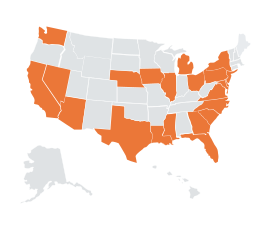
- OPERA includes EHR data prospectively captured from 101 clinics across 23 US states and territories
Demographics
- Median age (IQR): 33 (27, 40) years
- Gender: 11% CGW
- Race/Ethnicity: 27% Black, 29% Hispanic
Objectives
- Describe baseline characteristics of APRETUDE and daily oral PrEP users
- Describe adherence to APRETUDE and usage patterns of oral lead-in
- Monitor incidence of HIV-1 infection and STIs
- Evaluate HIV treatment and virologic suppression after HIV acquisition
Inclusion Criteria
- HIV negative
- ≥18 years old at first APRETUDE injection
- ≥1 APRETUDE injection received between December 21, 2021 and June 30, 2024
HIV Incidence

- 2 HIV-1 seroconversions observed during APRETUDE use (0.3%)†
- Inconsistent HIV-1 testing may result in underreporting of HIV-seroconversions
- OPERA was not designed to identify AEs
Virologic outcomes after HIV acquisition
- The first person that seroconverted transferred care out of OPERA
- The second person that seroconverted was put on DRV/c/FTC/TAF and subsequently changed to BIC/FTC/TAF
- Genotype testing performed around the time of HIV diagnosis showed non-nucleoside reverse transcriptase and protease inhibitor mutations
This analysis was funded by ViiV Healthcare.3
Study limitations: Real-world studies are designed to complement clinical trial data and evaluate associations among variables, not to definitively establish causality. Data may better reflect actual patient populations and clinical care. Data are susceptible to bias. Observational studies have the potential for missing, inaccurate, incomplete, or overlapping data. No comparator arm was included.3
These results are descriptive. Data does not capture consistent HIV testing information with each APRETUDE injection. Individuals must be confirmed HIV-1 negative before starting APRETUDE or oral cabotegravir and before each APRETUDE injection, using an FDA-approved HIV-1 test for acute infection. Drug resistance has been observed in individuals with undiagnosed HIV-1 while on APRETUDE. Inconsistent HIV-1 testing may result in underreporting of HIV-1 seroconversions.
*Including individuals with ≥1 APRETUDE injection.
†2 additional HIV acquisitions were observed 4 and 6 months after CAB LA discontinuation, respectively
-
TRIO (N=1696)²˒⁵˒⁶*
A real-world study of APRETUDE in diverse populations
Overview
Ongoing, 3-year, observational study of US adults starting APRETUDE in routine clinical settings.
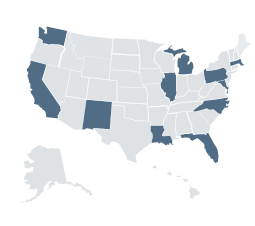
- TRIO HIV Research Database includes EMR data prospectively captured from 12 clinics across the US
Demographics
- Median age (IQR): 34 (28, 43) years
- Gender: 83% CGM, 14% CGW, 3% TGW
- Race: 52% White, 28% Black, 23% Hispanic or Latino
Objectives
- Describe usage patterns of APRETUDE
- Describe adherence to APRETUDE
- Monitor incidence of HIV-1 infections
- Monitor occurrence of HSR and DILI
- Evaluate resistance to INSTI among individuals with incident HIV-1 infection
Inclusion Criteria
- HIV-1 negative adults and adolescents (≥35 kg at initiation)
- ≥1 APRETUDE injection received between December 2021 and February 2025
- No participation in APRETUDE clinical trials
HIV Incidence

- 3 HIV-1 serconversions observed (0.2%)
- Inconsistent HIV-1 testing may result in underreporting of HIV-seroconversions
Virologic outcomes after HIV acquisition
- All individuals were treated with DRV/c/FTC/TAF; 2 achieved virologic suppression during 2 months of follow-up
- No resistance mutations were detected in the first 2 individuals; testing was not performed for the third individual
Select safety profile observed in TRIO†
No drug-induced liver injuries or hypersensitivity reactions were reported6
ISRs were recorded in 0.5% (n=3/526) of the study population; all discontinued6
In other settings:
- Serious or severe hypersensitivity reactions have been reported with cabotegravir and include Stevens-Johnson syndrome (SJS)/toxic epidermal necrolysis (TEN). Discontinue APRETUDE immediately if signs or symptoms of hypersensitivity reactions develop
- Hepatotoxicity has been reported in individuals receiving cabotegravir. Clinical and laboratory monitoring should be considered. Discontinue APRETUDE if hepatotoxicity is suspected
This analysis was funded by ViiV Healthcare.6
Study limitations: Real-world studies are designed to complement clinical trial data and evaluate associations among variables, not to definitively establish causality. Data may better reflect actual patient populations and clinical care. Data are susceptible to bias. Observational studies have the potential for missing, inaccurate, incomplete, or overlapping data. No comparator arm was included.6
These results are descriptive. Data does not capture consistent HIV testing information with each APRETUDE injection. Individuals must be confirmed HIV-1 negative before starting APRETUDE or oral cabotegravir and before each APRETUDE injection, using an FDA-approved HIV-1 test for acute infection. Drug resistance has been observed in individuals with undiagnosed HIV-1 while on APRETUDE. Inconsistent HIV-1 testing may result in underreporting of HIV-1 seroconversions.
*Including individuals with ≥1 APRETUDE injection.
†These safety results are based on a 2-year interim analysis (N=526) of individuals who received ≥1 injection of CAB LA for PrEP between December 2021 and January 2024.
Talk to a ViiV Healthcare resource to learn more about the real-world studies of APRETUDE

Review safety data from HPTN 083 and HPTN 084
View expert discussion from colleagues
Watch Dr Koppany Visnyei discuss the efficacy and safety of APRETUDE

PMUS-CBTWCNT260005
References:
Hsu RK, Brunet L, Mills A, et al. Cabotegravir LA for PrEP: Progress in HIV Prevention from Three Years of OPERA Data. Poster presented at: Conference on Retroviruses and Opportunistic Infections; February 22-25, 2026; Denver, Colorado.
- Elion R, Sridhar G, McEwen I, et al. Long term use, HIV testing and effectiveness in individuals on CAB LA PrEP in the Trio health cohort. Poster presented at: Conference on Retroviruses and Opportunistic Infections; February 22-25, 2026; Denver, Colorado.
- Mills AM, Brunet L, Frost KR, et al. Real world data on on-time dosing, HIV testing and HIV acquisition from the OPERA cohort. Presented at: IDWeek; October 19, 2024. https://www.natap.org/2024/IDWeek/IDWeek_20.htm
- Mills AM, Brunet L, Mounzer K, et al. Pre-exposure prophylaxis with cabotegravir long-acting injectable in the OPERA cohort. Presented at CROI; March 3-6, 2024.
- Data on File, ViiV Healthcare.
- Ramgopal M, Brown C, Frick A, et al. Real-world use of cabotegravir long-acting for pre-exposure prophylaxis (PrEP): data from Trio Health cohort. Presented at IDWeek; October 16-19, 2024. https://viivhcmedinfo.com/medical-congress/idweek-2024/
- Heise MJ. High retention and adherence with rapid long-acting injectable PreP implementation in an urban safety-net clinical population. Presented at HIVR4P; October 6-10, 2024. https://www.natap.org/2024/HIVR4P/HIVR4P_28.htm
- Turner C, Wagner GA, Pfeil A, et al. Implementing long-acting cabotegravir for HIV PrEP in a large academic hospital-based urban HIV clinic. Presented at HIVR4P; October 6-10, 2024. https://www.natap.org/2024/HIVR4P/HIVR4P_10.htm
- Hazra A, Schneider J, Murray M, et al. Insurance type drives cabotegravir delays: real-world long-acting PrEP outcomes in the Midwest US. Poster presented at CROI; March 3-6, 2024. https://www.croiconference.org/wp-content/uploads/sites/2/posters/2024/1241.pdf
- Altamirano A, Shukla P, Barnett SK. Early real-world experience of long-acting cabotegravir (CAB) for HIV pre-exposure prophylaxis (PrEP) in a large community-based clinic network (CAN Community Health): utilization and PrEP persistence. Poster presented at: OFID; October 13, 2023.
- Holder H, et al. Patient Experiences at Month 6 after Initiation of Cabotegravir Long-Acting (CAB LA) for PrEP in the First Male Gender Concordant Implementation Science Trial (PILLAR) in the US. Poster presented at IDWeek; October 18, 2024.
- Baker DM, Nelson KL, Mocherla S, et al. Change in healthcare professionals’ identification, counseling, and adherence with black women for long-acting cabotegravir (CAB LA) for PrEP across women’s health, primary care, and infectious disease sites: findings from the EBONI study. Poster presented at ID Week; October 16-19, 2024. https://www.natap.org/2024/IDWeek/IDWeek_18.htm
- Traeger M, Leyden W, Volk J, et al. Long-acting cabotegravir PrEP uptake and persistence in a large U.S. Healthcare system. Presented at: CROI; March 12, 2025. https://www.natap.org/2025/CROI/croi_38.htm
- Patel RR, Golden M, Eric Kelley, et al. Feasibility of long-acting injectable cabotegravir PrEP initiation and administration by community health workers and early aspects of the PrEP injection care continuum in a primary care center in Washington, D.C. Presented at: IAS; 23-26 July 2023. https://www.prepwatch.org/resources/feasibility-of-long-acting-injectable-cabotegravir-prep-initiation-and-administration-by-community-health-workers-and-early-aspects-of-the-prep-injection-care-continuum-in-a-primary-care-center-in-wa/